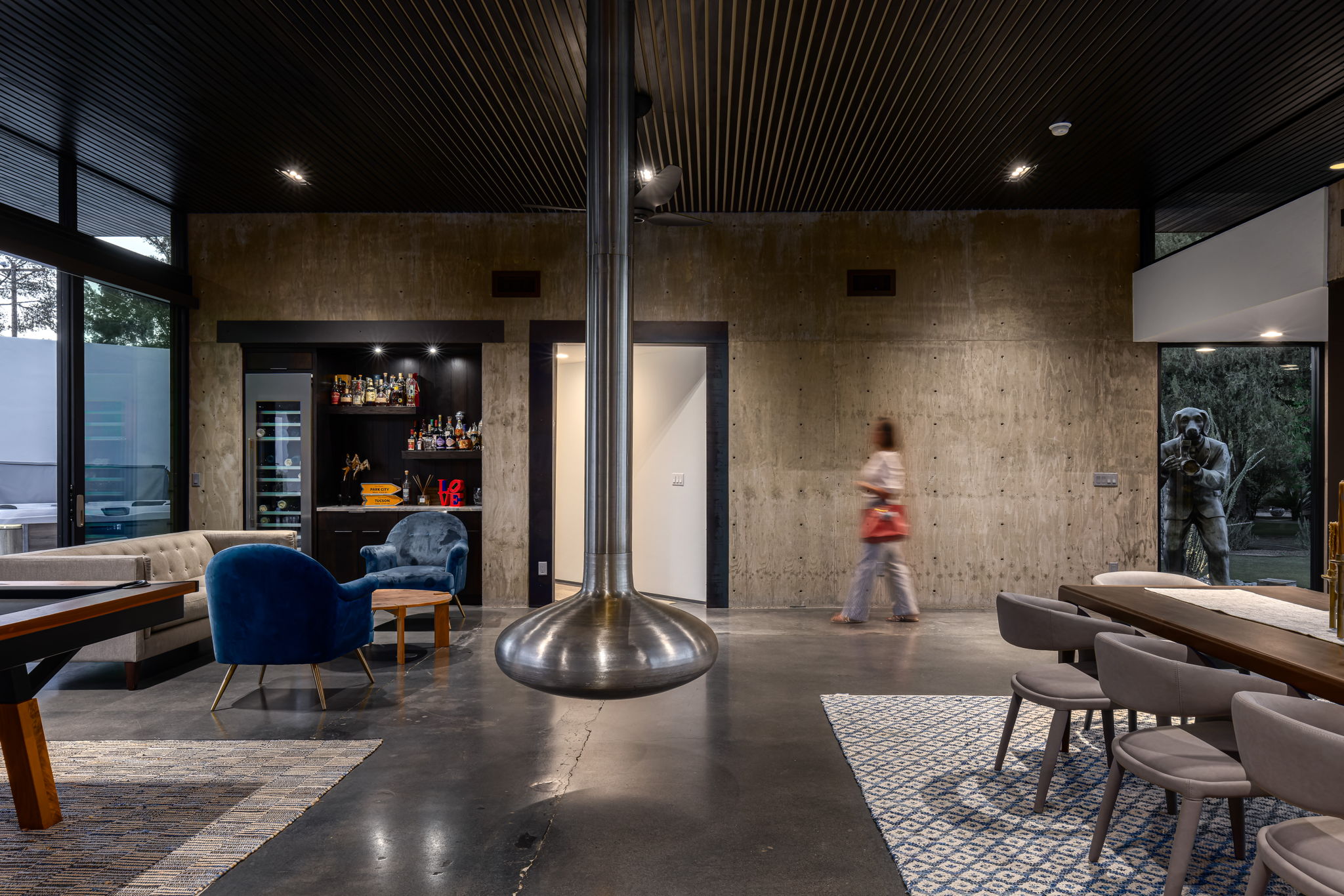
Some buildings are built for looking. Some are built for living. The two ask for different photography — different angles, different timing, different ways of seeing through the camera. There is a house in Tucson’s Country Club Estates that fell solidly in the second category. Glass walls face the Catalinas to the north and the backyard to the south, and the main living space sits between the two like a long room of light. The architecture invites you to walk in, set down a glass, cross to the window. It was built for living, not for looking. We were commissioned to photograph and film it, and that distinction shaped how we approached the work.
This piece is about a discipline we keep returning to: bringing narrative to architectural work, whether the medium is still or moving.
Le Corbusier once described architecture as the learned game, correct and magnificent, of forms assembled in the light. He wasn’t talking about photography. But the line is the closest description I’ve ever read of what architectural photography is actually trying to do.
A building is not a static object. It is the result of someone’s argument about how people should live, work, gather, or be alone. It is a sequence of decisions about light and material and proportion that, taken together, make a claim about the world. Every building you can name is a story someone authored.
The question I want to address here is the one most people don’t think to ask: when we photograph or film a building, are we documenting the story, or are we telling it? The honest answer is that the second is harder, less common, and worth dramatically more.
The difference between documentation and narrative.
Most architectural photography is documentation. The photographer arrives, sets up, captures the building from the conventional angles, processes the files, and delivers them. The result is technically clean, broadly accurate, and rhetorically empty. It tells the viewer what the building looks like. It does not tell the viewer what the building is for, what it feels like to be inside, what the architect was reaching toward, or why the work matters.
This is the photography that fills MLS listings, real estate brochures, builder portfolios, and the back pages of regional design magazines. There's nothing wrong with it as documentation. It's serviceable. It performs a function.
But narrative photography does something different. Narrative photography understands that the building is making an argument, and uses the frame, the light, the composition, and the sequence to amplify that argument. The viewer doesn't just see the building — they understand something about it that they couldn't have understood without the photograph.
The architect Beatriz Colomina has written about how architecture itself is not just a passive container for the viewer — it is, in her framing, a viewing mechanism in its own right. A building shapes how its occupants see the world. Good architectural photography is a viewing mechanism layered onto a viewing mechanism — the photographer's eye guiding the viewer through the architect's eye guiding the occupant. When this works, the photograph stops being about the building and becomes about what the building was reaching for.
That's narrative. That's the work worth doing.
The architect is the author. The photographer is the translator.
I think a lot about the relationship between the architect and the architectural photographer. It is not the same as the relationship between a chef and a food photographer, or between a designer and a product photographer. It is more like the relationship between a novelist and a translator.
The architect has authored something — a building, complete with intent, sequence, atmosphere, and meaning. That work is fluent in its own language: the language of stone and glass and shadow and proportion. The architectural photographer's task is to translate that language into the language of the two-dimensional image, in a way that preserves the meaning the architect built into it.

A bad translator hands you a literal version of the original — accurate at the word level, dead at the level of meaning. A good translator delivers the feeling of the original, sometimes by departing from the surface to preserve the substance. Architectural photography is the same. A literal photograph of a building can entirely miss what the building is. A photograph that bends slightly — choosing this angle over that one, this hour over that one, this shadow length, this depth of field — can deliver more of the architect's actual meaning than a thousand documentary frames.
This is why the best architectural photographers spend so much time reading the building before they shoot it. Walking through it. Asking the architect what they were trying to do. Sitting in it at different hours of the day. The work of the photograph happens before the camera comes out.
What a story-driven photograph does that a documentary one doesn't.
Three things distinguish narrative architectural photography from documentary architectural photography. They're worth understanding because they're the things you can ask for, look for, and hire for.
A story-driven photograph chooses a point of view. Documentary photography pretends to be objective. It positions the camera in the obvious place, captures the obvious view, and presents itself as a neutral record. Narrative photography is honest about being authored. It says: this is the angle from which the building is most fully itself. The photographer is making a claim, not just a record.
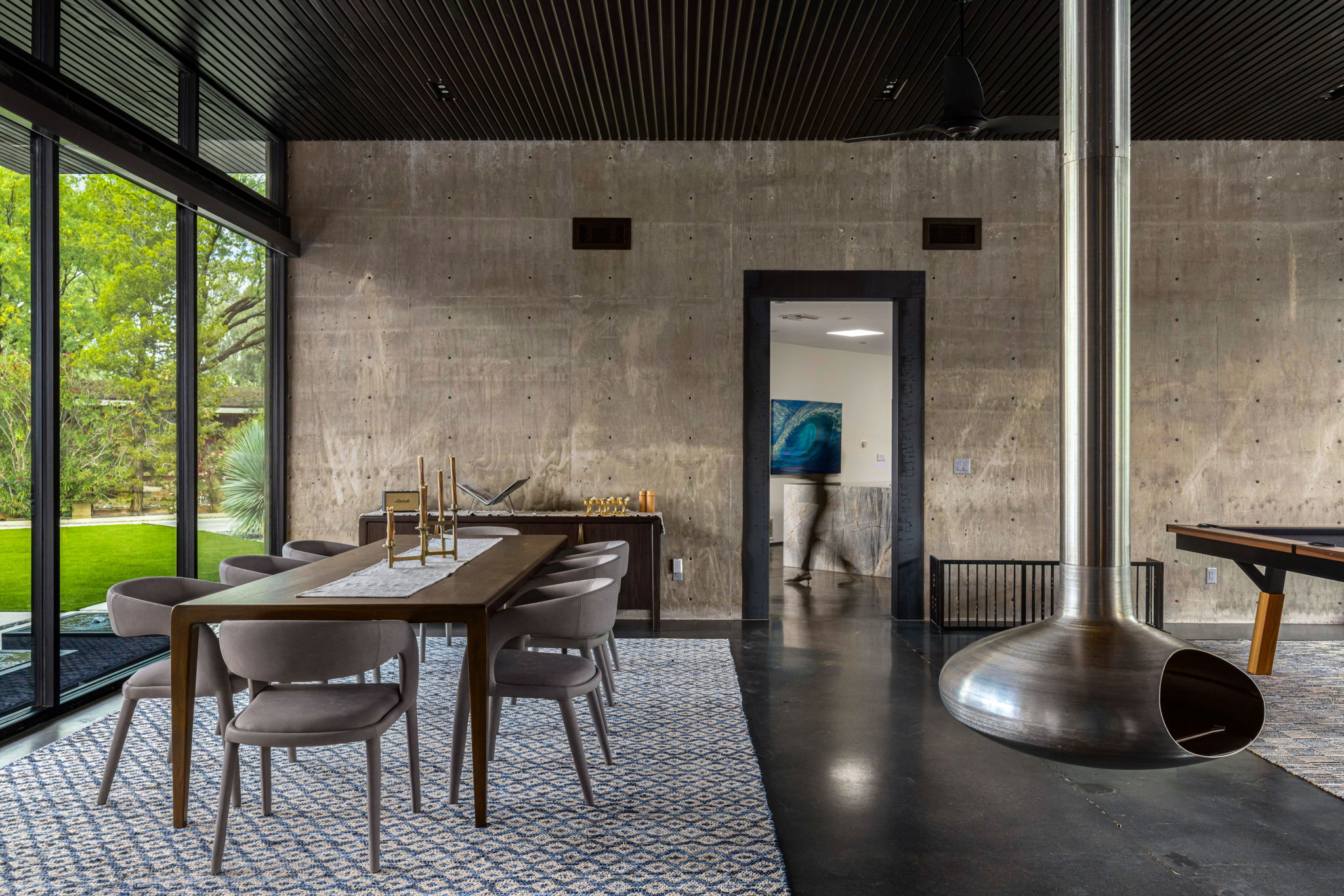
A story-driven photograph reveals something the casual observer would miss. Walk through any well-designed building and there are details — material transitions, joinery, the way light falls on a specific surface at a specific hour, the relationship between two seemingly disconnected rooms — that the architect put real labor into and that the average occupant will never notice. Narrative photography surfaces these. It directs attention. It teaches the viewer how to see the building.
A story-driven photograph leaves room for the viewer to inhabit it. This is the subtlest of the three. A great photograph of a building isn't a closed statement; it's an open one. There's room for the viewer to step into the frame imaginatively, to wonder what the rest of the building is like, to feel something about being there. Documentary photography forecloses this — it shows you everything at once and leaves nothing to want. Narrative photography is more disciplined. It shows you enough to draw you in, then trusts you to do the rest.
The same discipline, in moving image.
Everything above applies to film too. The questions are identical. Where is the building's argument? What does the camera reveal that the casual observer would miss? How do we leave the viewer room to imagine being there? The medium changes; the discipline doesn't.
If anything, narrative is more demanding in film than in stills. A photograph carries a single moment forward in time; the viewer holds the frame in their attention for as long as they want. A film carries a window of time forward at a fixed rate. Every second has to earn its place. The cinematic frames worth holding are the ones where the building does something that empty rooms can't. Light shifting across a wall during a held shot. A figure passing through a doorway and out of sight. The moment in late afternoon when the architecture seems to inhabit itself.
Most of our serious projects are commissioned for both deliverables — photography and film, scheduled together, planned around the same windows of light. The two disciplines feed each other. Stills made on a film set are stronger because the eye is already trained to think in sequence. Film made alongside a stills shoot is stronger because every frame has been considered as a potential photograph.
Why this matters, commercially.
I want to step out of the philosophical register for a moment and address the practical question: does narrative photography actually do better commercial work than documentary photography?
The honest answer is yes, dramatically — but not in the ways most people expect.
A piece of documentary architectural photography is functionally interchangeable with any other piece of documentary architectural photography. If your project's images look like every other project's images, the photography isn't doing strategic work for you. It's a baseline expense, not a value-added asset.
A piece of narrative architectural photography is not interchangeable. It positions the project. It tells the story the architect wants told, in a way that travels — to the press, to the awards committee, to the next prospective client, to the architect's monograph fifteen years later. The photograph becomes a vehicle for the project's reputation, not just a record of its existence.
For a $12M home, a $60M development, a flagship hospitality property — the difference between documentary and narrative photography is the difference between a project that is seen and a project that enters the conversation. The first one might sell. The second one builds a body of work that compounds.
This is, in plain language, why a serious developer or architect is willing to pay for serious photography. Not because the photos are technically better. Because the photos do more.
The story is in the building. We just have to find it.
Here's the thing I want to leave you with, because it's the lesson I've taken longest to learn.
Every building is already telling a story. The story isn't something we bring to the frame. It's something the architect has already woven into the structure — the materials, the proportions, the relationship to the site, the way the light enters at certain hours, the sequence of spaces from entry to interior. Our job is not to invent a narrative. It's to find the one that's already there and make it visible.
When this works, the photograph isn't about the building. It is the building, translated into a different medium. The architect recognizes their work in it. The viewer, who may have never seen the building in person, somehow understands what it would be like to walk through it. The photograph carries the building outward — into the press, into the next client's imagination, into the long memory of the place.
That's the difference between showing a space and telling its story.
We're trying, every shoot, every time, to do the second.