Before we set up a single light or lay a hand on a camera, we walk the entire home.
Not to admire it — to read it. Every exterior-facing window gets noted: which direction it faces, what hour the light will be right, whether the adjacent interior is working with it or fighting it. We’re building a schedule before we’ve pressed anything.
This home in the Foothills, built by Dove Mountain Homes, demanded more of that planning than most. The steel-frame windows and doors throughout — by Pinky’s Iron Doors — face nearly every direction, and Contemporary Spanish Colonial gives you a lot of photographic material to work with: arches, plaster, timber beams, a site with real mountain presence. But sequencing the shoot matters as much as any single composition. You have to know which room to be in at what hour, or you miss it.
The arch is where you start.
Arched openings are one of the most reliable compositional tools in architectural photography — not because they’re decorative, but because they solve a specific problem: how do you show depth in a still frame? An arch gives you a foreground and whatever lies beyond it in a single natural gesture. In this home they appear at every major transition, and we used every one.
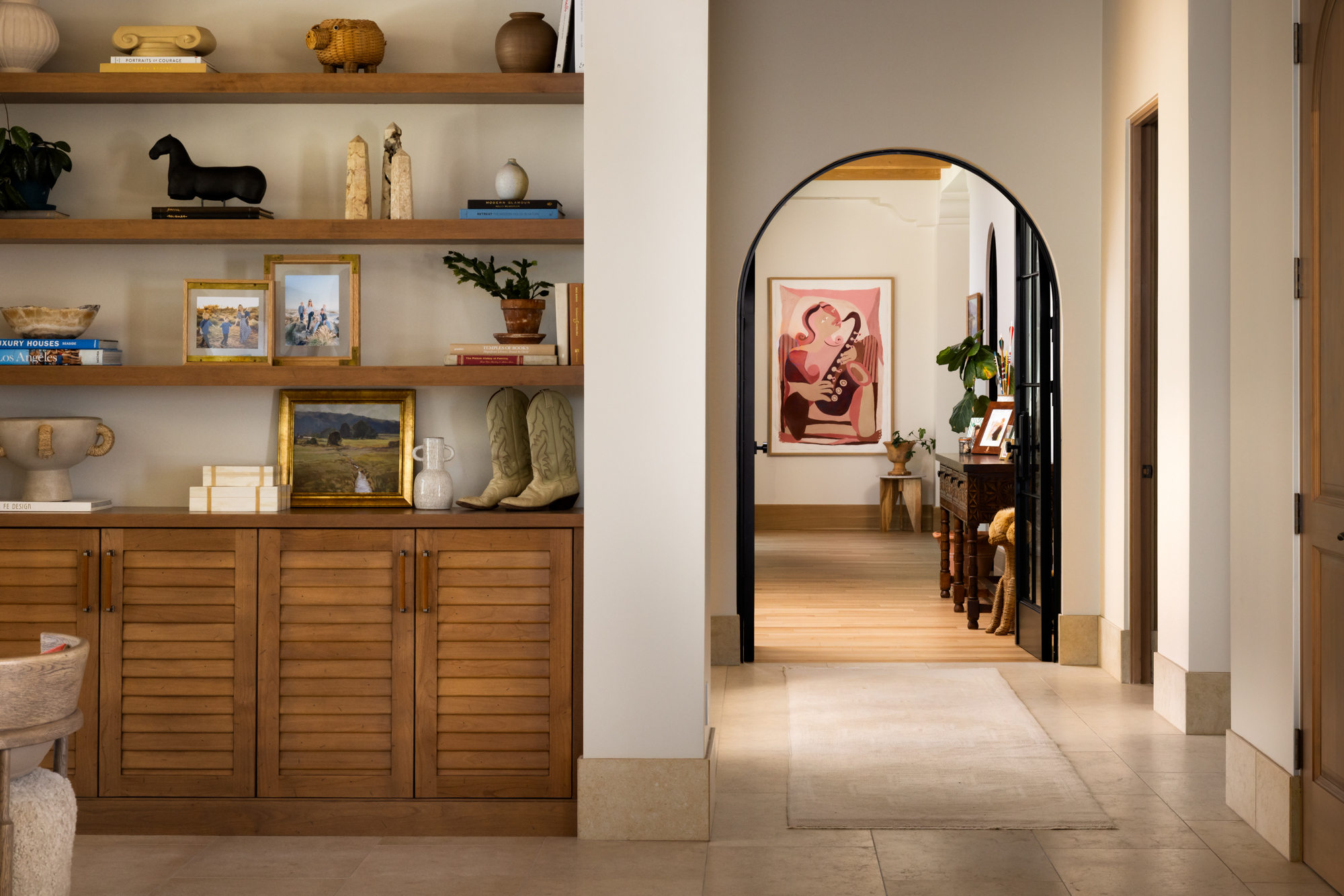
The bookshelf shot off the main hallway is a good example of how this works in practice. The arch is doing the compositional heavy lifting — framing the corridor, pulling the eye toward the artwork at the far end. Our job was to let it. We kept parallel to the wall so the arch reads true, not keystoned, and held the bookshelf in the foreground. The personal objects there speak to how the home is lived in, and the arch frames them without making them the subject. When an arch is in the foreground, you don’t compete with it. You find the depth behind it and wait for that to resolve.
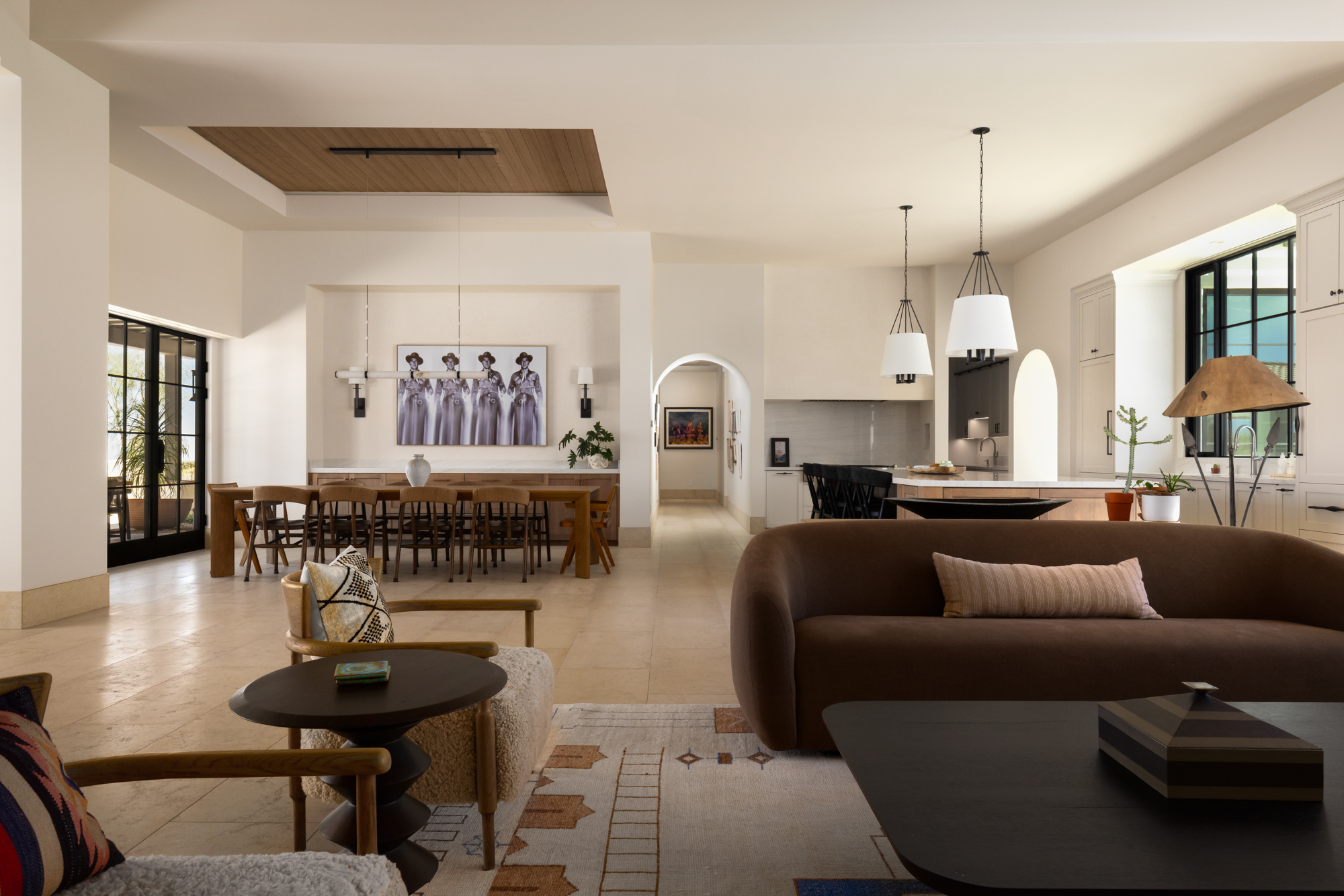
The wide interior view is the same principle at a larger scale. Open floor plans are easy to shoot badly — without a clear compositional structure, a big room just looks like a lot of furniture. We positioned the camera to hold at least two arches in the line of sight, which gave the frame a series of stopping points the eye can move through rather than a single wall of space to scan across.
White plaster is not a neutral surface.
Shoot it wrong — flat light, wrong angle — and white plaster reads like drywall: lifeless, paper-white, no surface character. Shoot it right and it holds the warmth of the room while the texture of the material comes through. The difference is almost entirely about the angle of light. We look for the rake — light arriving obliquely rather than landing flat — because that’s what reveals the surface rather than collapsing it.
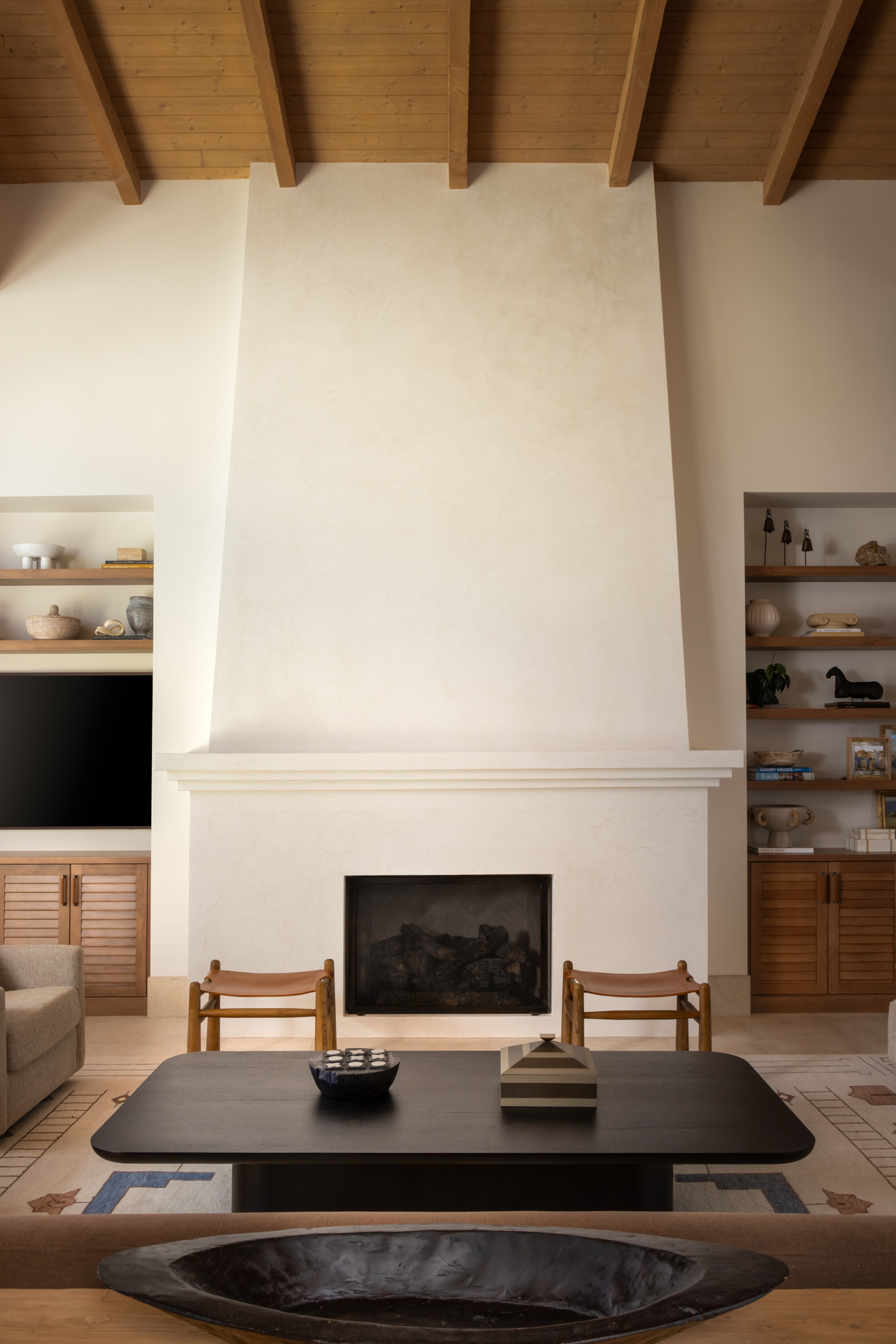
Inside, the fireplace is the room’s intended focal point — the designer made that clear in how the entire space is organized around it. When a room is built around a single vertical centerpiece at that scale, a centered axis shot isn’t a default; it’s the answer the architecture is calling for. We set the camera slightly below eye level to let the full height read against the beam ceiling above, and kept the frame wide enough that the symmetry of the built-ins on either side could confirm what the room is organized around. The goal was to give the fireplace the same prominence the designer gave it — not to reinterpret it, but to make that intention legible.
Outside, plaster requires a different read. At midday, direct sun on a white stucco exterior flattens it — no texture, no surface character, just paper-white. That’s not the hour for that shot. We plan around it and come back when the light is working with the material. Blue hour is usually the answer: the facade holds the sky’s last color, the interior lights come on behind the glass, and the plaster becomes luminous rather than just white.
The Pinky’s windows are a compositional tool.
The steel-frame windows and doors throughout this home — fabricated by Pinky’s Iron Doors — are the clearest signal that this is a contemporary interpretation of the style rather than a reproduction. That distinction mattered for how we approached them. A Pinky’s window at this scale isn’t background material. It’s a design statement, and we treated it as one.
The camera decision that follows is about position more than anything else. Where you stand relative to the grid changes what the grid does within the frame. Too close and it dominates; too far and it becomes texture rather than structure. At the right distance — which we find by looking, not by formula — the steel bars become a compositional layer that organizes what’s behind them without competing with it. Through the grid: the mountain, the desert, or the valley at last light. For an architect, it’s also the frame that shows how the Pinky’s windows belong here not just stylistically, but architecturally — that the contemporary move and the traditional form are working together.
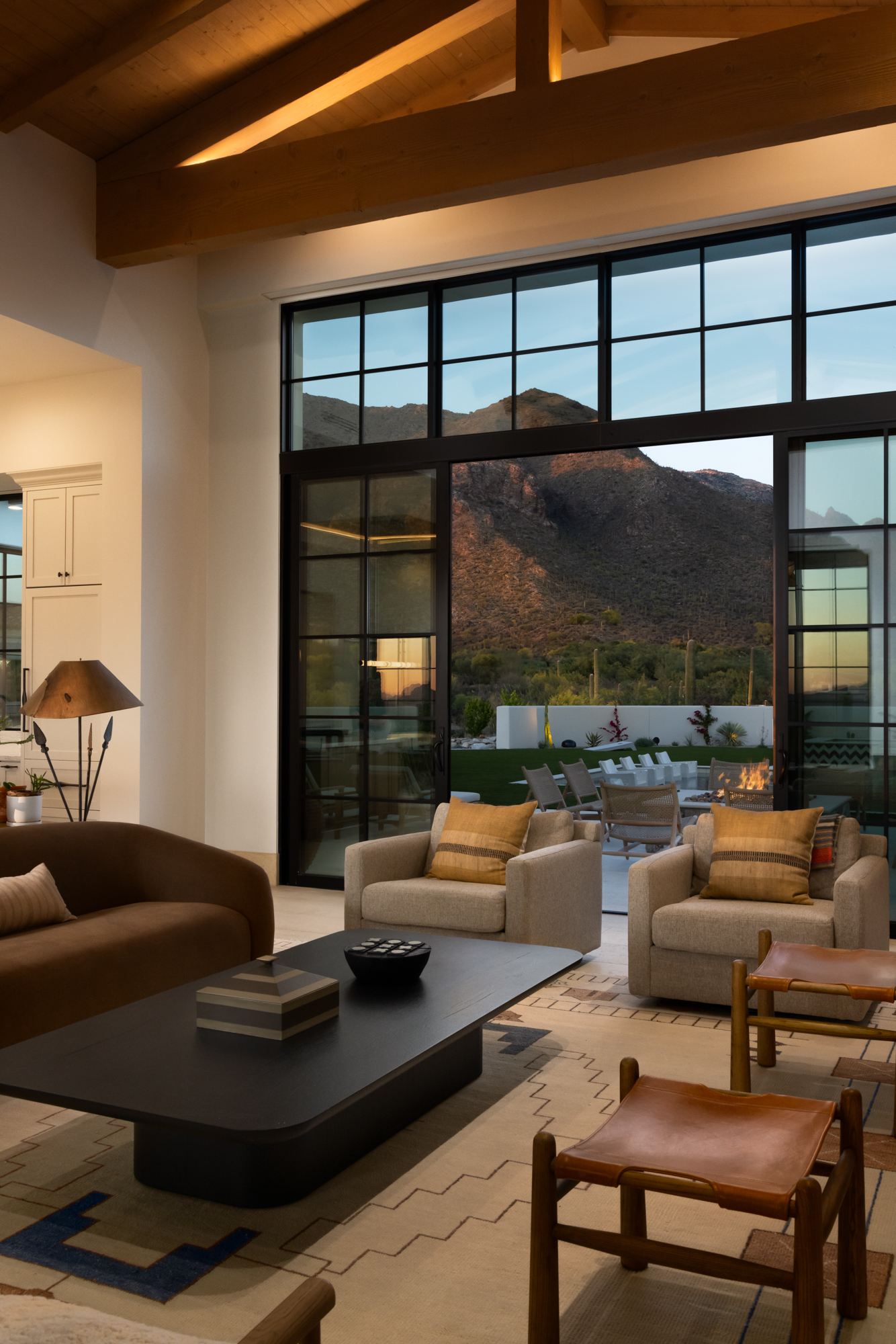
A home with this many exterior-facing windows — each one oriented differently, each one catching light at a different hour — has a different optimal shooting time for nearly every space. This isn’t something you figure out on the day; it’s something you plan before you arrive. We built the shoot schedule around the sun rather than the floor plan, moving from room to room as the light moved. The front of the home and the back have entirely different windows of time — we shot them separately, not simultaneously, because what works for one side actively works against the other.
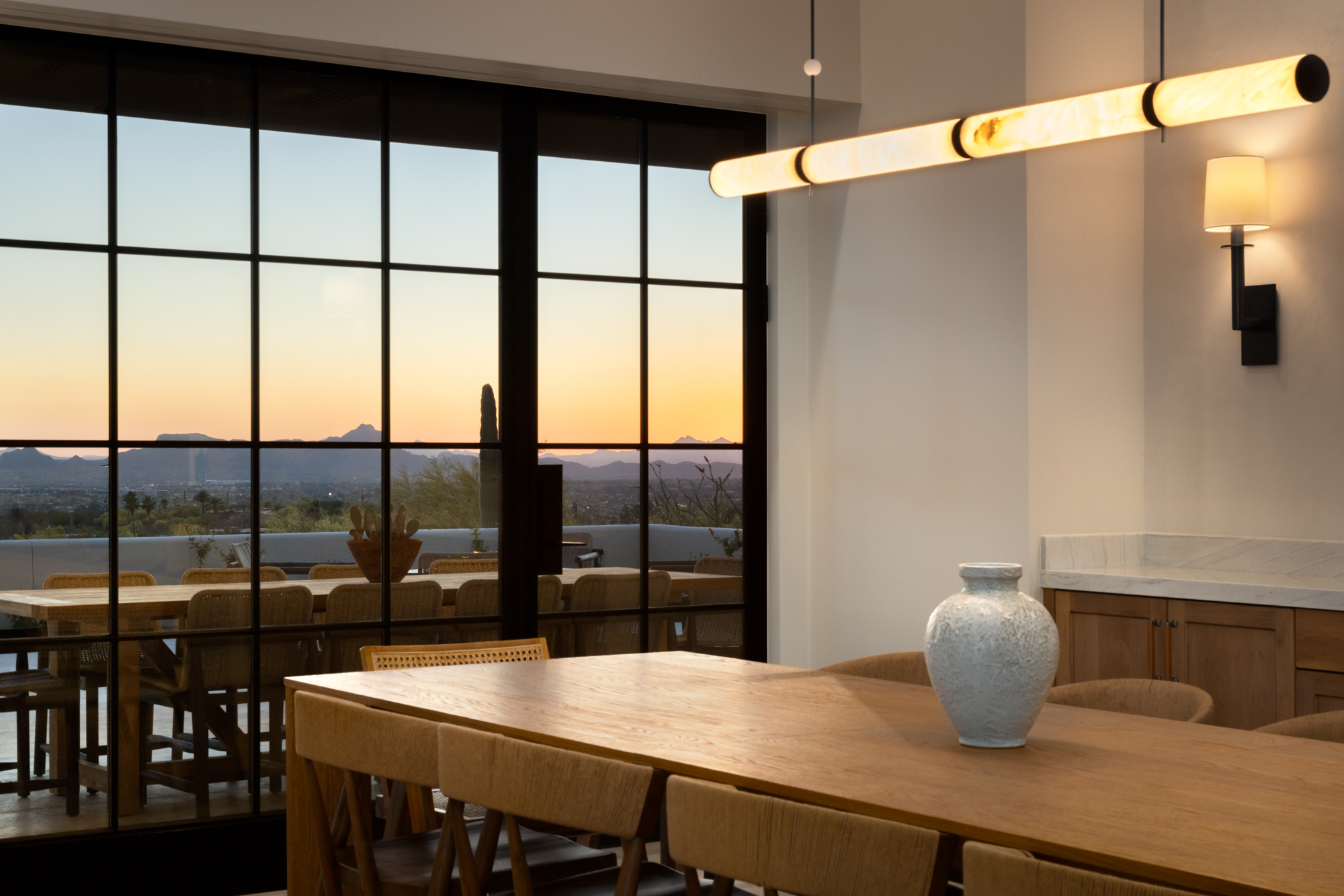
The interior-exterior window shot specifically only works when the light values on both sides are close to each other. Midday: the exterior is so much brighter that the glass blows out — you get the view, but you lose the room. Full dark: the interior is warm and lit, and the exterior disappears into black. The window we’re looking for is roughly the thirty minutes on either side of sunset — interior ambient light still warm from the fixtures, exterior light cooling fast, the sky running from amber at the horizon to deep blue overhead. Miss it by thirty minutes in either direction and you’re shooting a different photograph.
In the dining room, we waited for that balance. The alabaster tube pendant holds its warm glow. The wood table reads clearly in the foreground. Through the grid, the valley floor spreads out below, and the last light on the horizon is still just bright enough to hold the mountain silhouettes against the sky. That shot is a decision about time as much as it is about composition. The balance is there for about thirty minutes, and then it closes.
Blue hour is when the home looks most like itself.
Blue hour is the other window we plan the entire day around, and it requires the same precision as the interior shots — just outdoors.
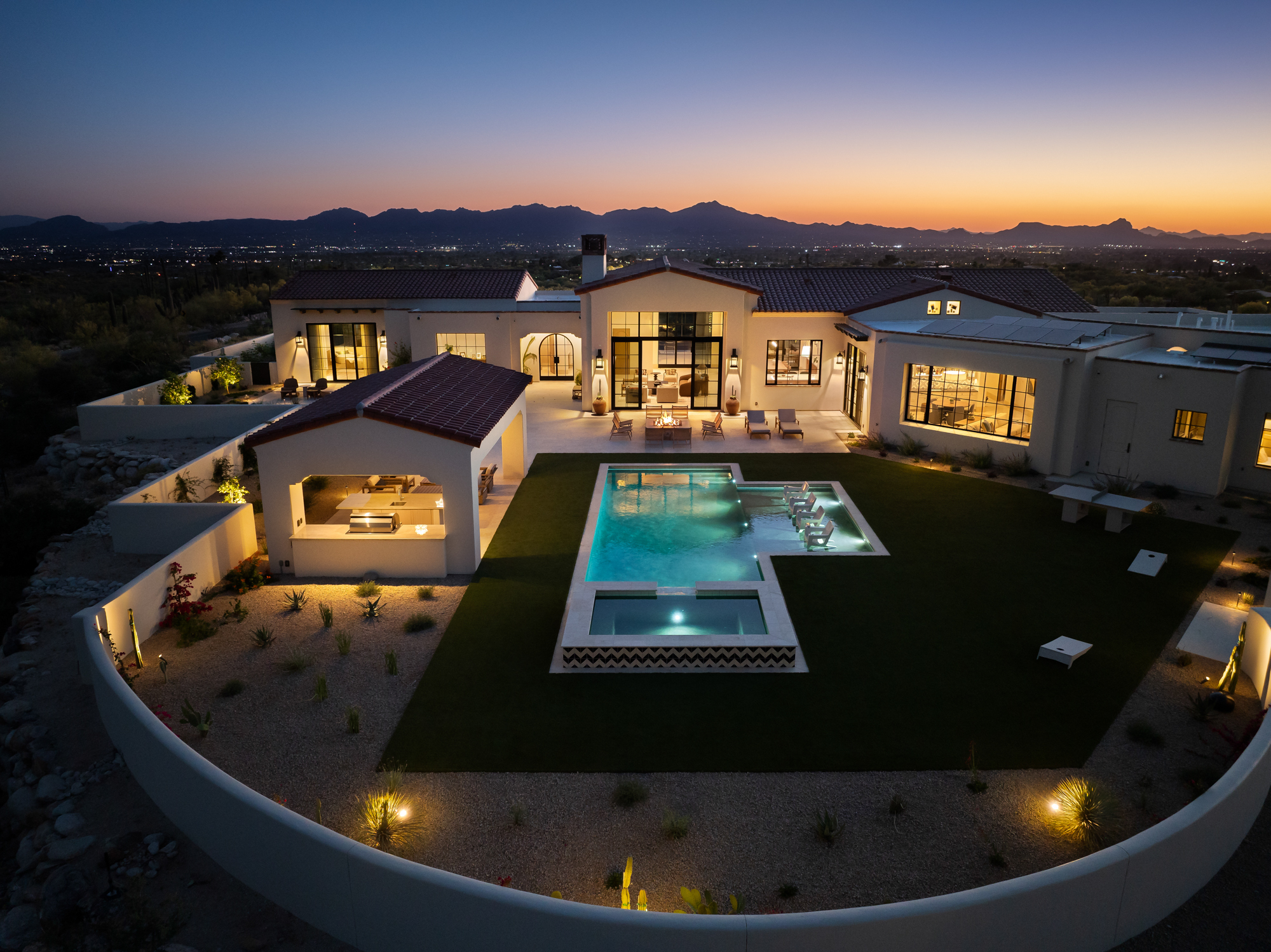
Blue hour does something to a home that no other light does: it makes it look inhabited. The interior warmth comes through the Pinky’s glass while the plaster cools outside; the lanterns at the entry are lit; the mountain behind is still present but beginning to recede into the dusk. This is the version of the home that communicates what it feels like to be inside it — not a construction record, but a place someone lives. For an architect or builder presenting their work, it’s the frame that makes the case for why every decision was the right one. The home looks most like what it was designed to be at exactly this hour, and that’s a direct result of how the site was positioned, how the materials were chosen, and how the openings were placed.
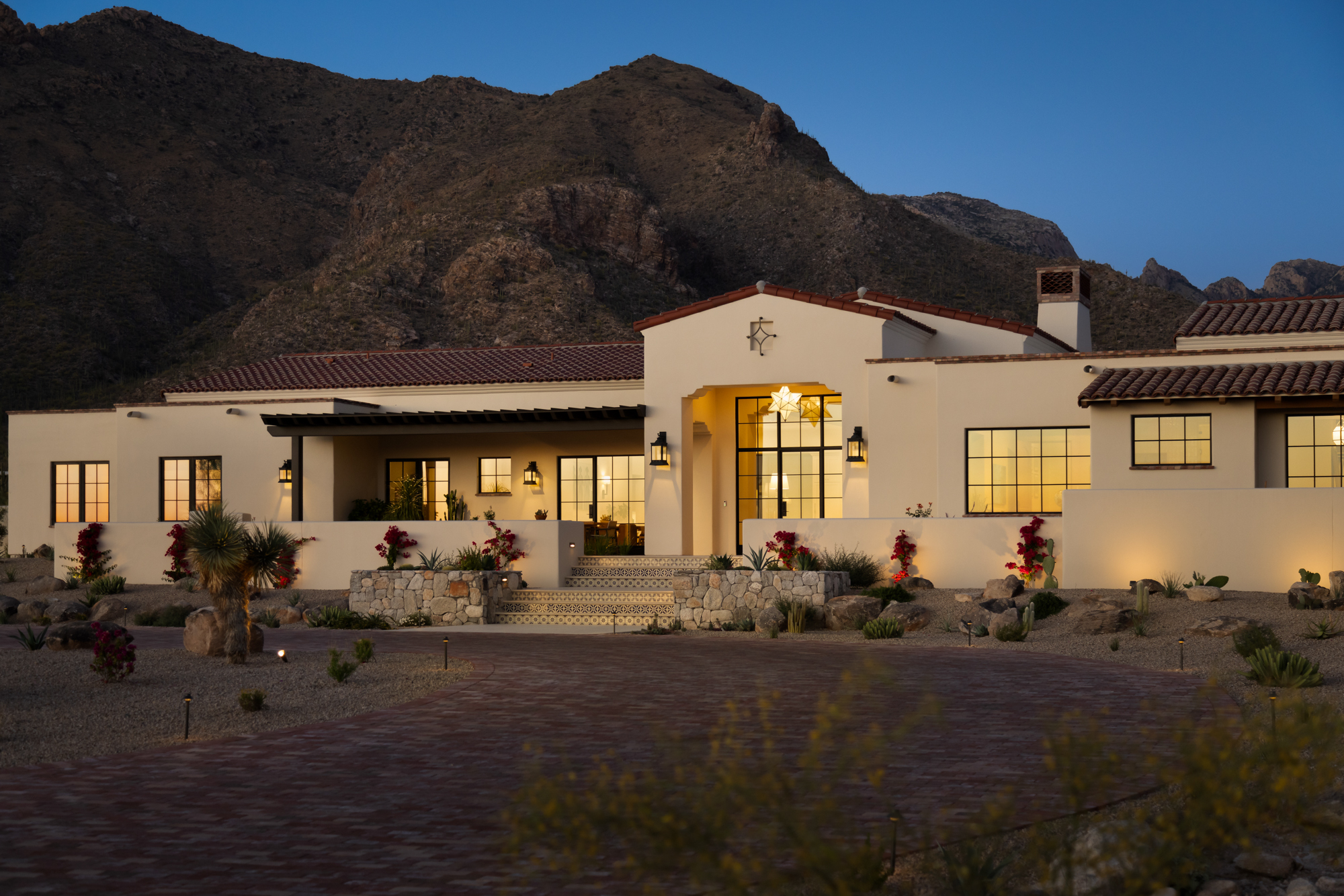
We pulled back far enough on the facade to hold the full mountain in the frame, because how this home sits on its site is one of the most deliberate decisions Dove Mountain Homes made. The positioning isn’t incidental — the mountain is part of the architecture. If you crop to just the building, you’ve lost half of what makes the shot worth taking.
The aerial at the same hour is a different kind of frame entirely — one that no ground-level position can replicate. From above, the full compound sequence is visible: main house, covered outdoor kitchen, pool and spa, all organized around the central outdoor living space, the curved retaining wall holding the composition together. Beyond it, the valley floor, city lights beginning to appear, the mountain silhouettes at the horizon. This is the frame that shows where the home lives, not just what it looks like.
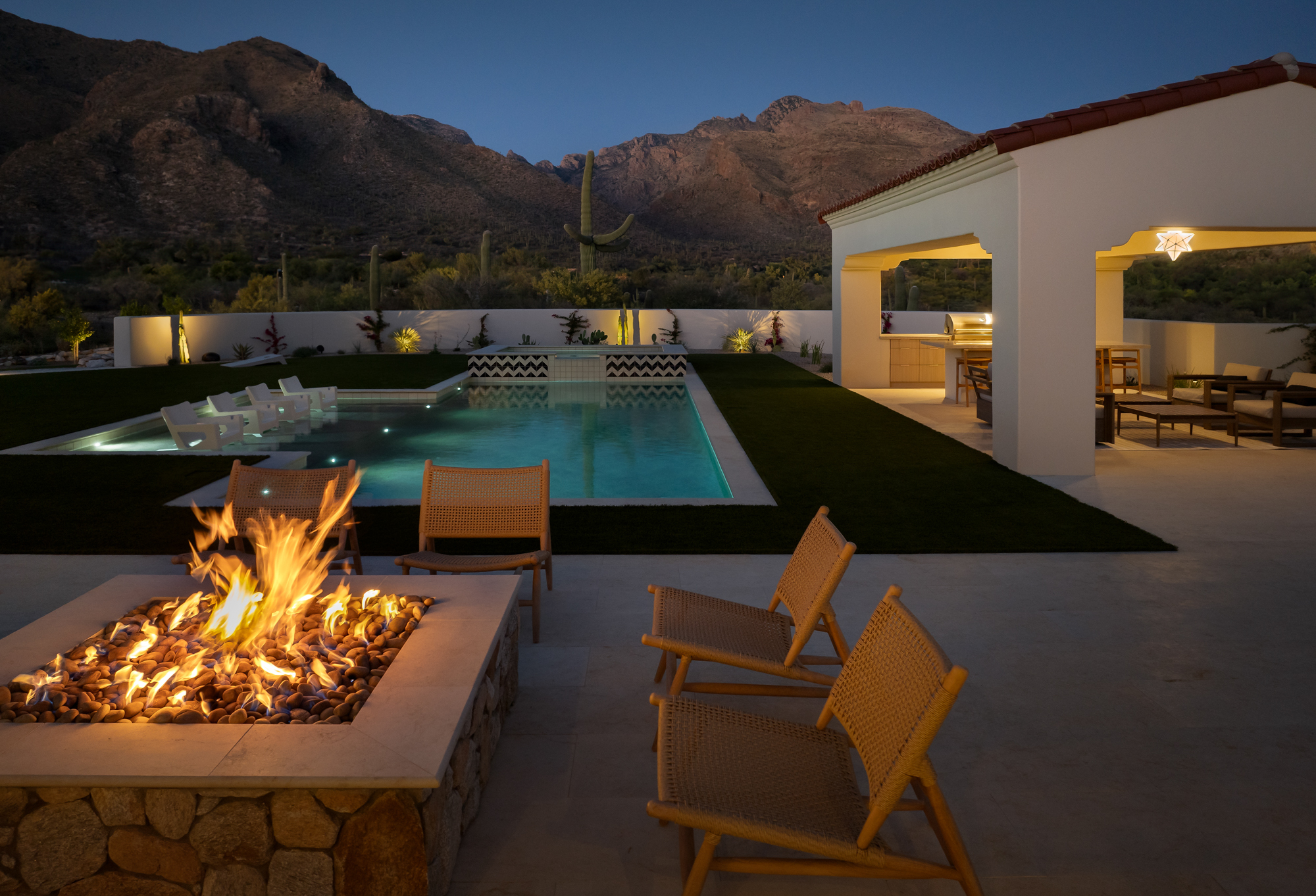
Back at ground level, the fire pit is a different position on the same scene. We framed to hold the flame in the foreground, the pool and covered outdoor kitchen behind it, and the mountain above — not picking any one element but showing how they’re all in conversation with each other. The build is designed to be experienced as a whole, and the frame should show that.
Contemporary Spanish Colonial done well is a specific blend, and photographing it well means understanding both halves. Dove Mountain Homes built the traditional vocabulary clearly — arches, plaster, timber beams, terracotta tile — and made specific contemporary moves on top of it: the Pinky’s steel-frame windows and doors, the open floor plan, the scale of the glazing. Neither half reads without the other, and the photography has to make both legible in the same frame.
That’s what the planning is for. The schedule built around the light. The camera position found by moving and looking. The hour chosen because we understand what the builder intended and what the space is designed to do at that moment. When you know what was built and why, you know where to stand, when to be there, and what the frame needs to show.